Aten Security joins Anthropic's Cyber Verification Program
Aten Security has joined Anthropic's Cyber Verification Program. We explain how we'll use the access to test Thoth's authorization checks, SDKs, and execution evidence.

Aten Security
September 8, 2026 · 5 min read

Aten Security Joins Anthropic’s Cyber Verification Program
Anthropic has approved Aten Security for its Cyber Verification Program, supporting our authorized dual-use cybersecurity work with Claude.
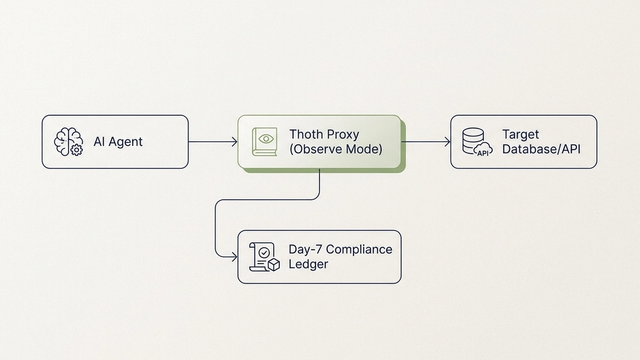
This access will support our defensive evaluation work on Thoth, Aten’s runtime authorization platform for AI agents. Our focus is the point where an agent’s proposed action becomes a real operation: a tool call, an API request, or a change to a system.
As agents take on more consequential work, security teams need evidence that permissions hold throughout execution. We plan to use this access to make those evaluations more demanding and more useful to the teams deploying agents.
Why this matters for agent security
An agent can start with a legitimate task and encounter untrusted instructions along the way. A retrieved document, tool response, or repository file might attempt to redirect it toward a different resource or operation. A workflow can also exceed its authority without an attacker: the agent may select the wrong target, reuse an old approval, or continue after its permissions change.
Consider a coding agent authorized to inspect a staging environment and propose a configuration change. A human approves a specific change to a specific service. Before execution, the agent substitutes a production target.
The evaluation must establish whether the original approval can authorize that changed action, whether the connector actually performs it, and what evidence reaches the security team. A reassuring model response or a log entry marked “blocked” cannot answer all three.
Anthropic’s approval gives us more room to exercise the authorized dual-use scenarios covered by our application and investigate how the enforcement path behaves.
What we plan to evaluate
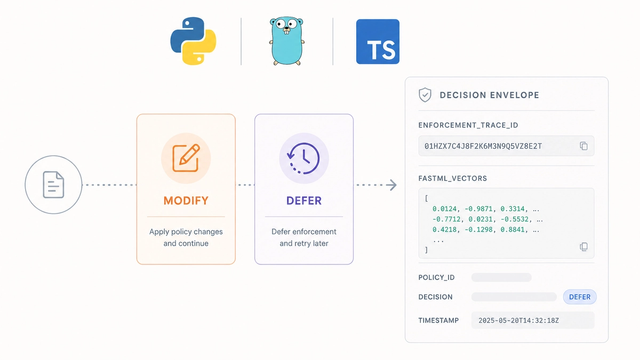
Thoth’s SDK integrations place policy checks before governed tool actions. Our next evaluations will follow the complete path from the agent’s request through the policy decision to the observed effect and the evidence available to customers.
The work will cover four areas:
- Authorization under adversarial input. Test whether instructions introduced through documents, tools, and application data can cause an integrated agent to act outside its assigned permissions.
- Approval integrity. Exercise changed arguments, substituted targets, expired approvals, and replay attempts. Confirm that legitimate approvals still allow the intended work to complete.
- SDK behavior and failure handling. Run equivalent scenarios through Python, Go, and TypeScript integrations. Check what happens when a required service is unavailable, a request times out, or an action is retried.
- Evidence that supports investigation. Trace the requested action, relevant identity and policy, controlling decision, required approval, and observed outcome. Measure missing or delayed evidence alongside enforcement results.
The result we want customers to be able to inspect is a record of the control operating: the action attempted, the authority it carried, the decision made, and what actually happened.
Measuring protection at the execution boundary
A provider refusal and an authorization decision are different events. If Claude declines a request before a tool call reaches Thoth, that result tells us about the provider’s safeguards. It does not demonstrate that Thoth enforced the customer’s policy.
Our evaluation plan separates model responses, policy decisions, and actual tool effects. It also includes permitted actions, so an overly restrictive integration cannot appear successful simply by blocking useful work.
For reproducibility, we plan to retain test configurations, model and SDK versions, policy versions, expected outcomes, and observed results. Controlled environments and synthetic fixtures will let us examine these behaviors without relying on customer secrets or production data.
What the approval covers
The approval applies to Aten’s designated Anthropic organization and the use cases described in our application. Anthropic’s Usage Policy and ongoing monitoring continue to apply; prohibited activities remain restricted. It is an access approval, not a certification or endorsement of Thoth.
We appreciate Anthropic’s Safeguards team supporting this work. As evaluations progress, we intend to share findings, limitations, and practical lessons for teams putting AI agents into production.
Learn more about Thoth or explore our developer documentation.
Get practical updates on AI agent security and governance.
Research, product updates, and practical notes on securing AI-agent workflows.