The AI Agent Instrumentation Tax: Lessons from 1,000 Hours of Runtime Telemetry Staging
What happens when you stage autonomous AI agents in production pipelines? A raw, 14-day engineering post-mortem breaking down runtime telemetry mapping, active policy simulation, and the reality of the developer 'instrumentation tax'.

Nyah Check
June 8, 2026 · 6 min read
Executive Summary
As engineering organizations begin staging autonomous AI agents within developer workflows, an operational governance gap quickly emerges: agents execute complex tool calls and infrastructure queries, but traditional logging pipelines lack agentic context.
To evaluate solutions to this visibility gap, we executed a 14-day design partner pilot using Thoth, Aten Security’s runtime control plane. The evaluation focused on three primary vectors: telemetry attribution tracking, active policy simulation, and the ongoing developer maintenance overhead required to sustain agent instrumentation.
Performance Metrics at a Glance
| Evaluation Vector | Operational Reality & Pilot Outcome |
|---|---|
| Attribution Coverage | 100% context capture across all in-scope agent tool calls. |
| Session Traceability | End-to-end trace mapping for both active agents achieved within 72 hours. |
| Active Policies | 8 specialized deterministic policy bundles (Data Exfiltration rules, Token access limits, Rate-limiting guards, and Scope validation). |
| Enforcement Simulation | Successful simulated STEP_UP and BLOCK triggers with 0% operational workflow disruption. |
| ML Scoring Tier | Restricted to deterministic heuristic fallback; baseline data generation required full window. |
| Operational Friction | High manual maintenance overhead on rapidly mutating agent tool schemas. |
The Challenge: Velocity vs. Visibility
Deploying autonomous helper agents into fast-moving engineering environments introduces unique guardrail challenges. The core operational risk is rarely a catastrophic system failure; instead, it is the silent execution of out-of-scope tool actions that fail to leave a structured, compliance-ready audit trail.
Furthermore, because these internal agentic tools are under continuous, rapid development by engineering teams, any successful governance framework must prove it can keep pace with highly volatile tool schemas without slowing down product velocity.
"When production agents are subject to a high frequency of code changes and schema updates, the governance tooling must keep pace with that software lifecycle automatically; otherwise, it creates an ongoing maintenance tax on the developers." --CISO, Payments Infrastructure Design Partner
Deployment Architecture & Findings
The deployment was executed in two structured phases over a 14-day testing window:
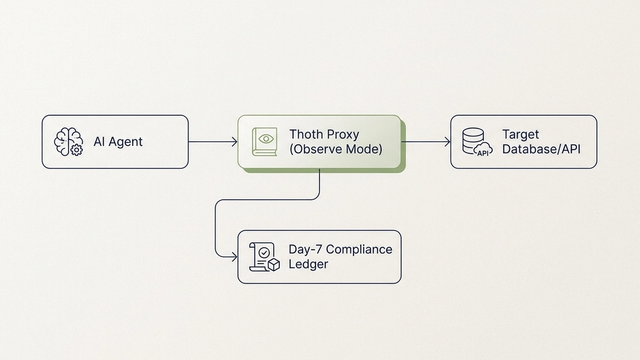
- Phase 1: Shadow Observation (Days 1–7): Thoth monitored scoped developer workflows passively to map behavioral fingerprints and validate attribution chains without intercepting data paths or affecting payload execution.
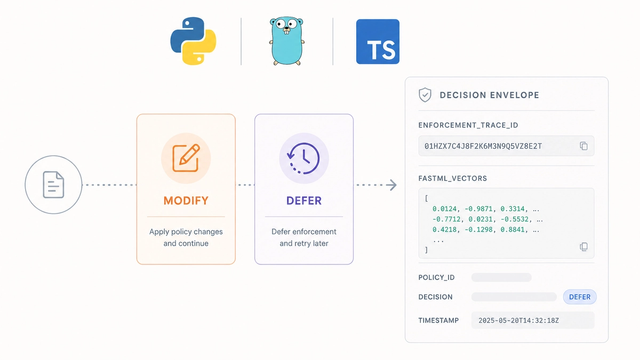
- Phase 2: Policy Enforcement Simulation (Days 8–14): Inline policy engines evaluated simulated agent intents against pre-configured rules, executing deterministic outcomes on high-risk triggers in a non-blocking state.
The pilot yielded two primary technical insights:
1. Immediate Contextual Attribution
Every simulated agent action was successfully mapped to its originating user session, target tool schema, runtime arguments, and final execution state. This unified an investigation process that typically requires manual, retroactive correlation across disparate system logs.
2. Frictionless Interception Staging
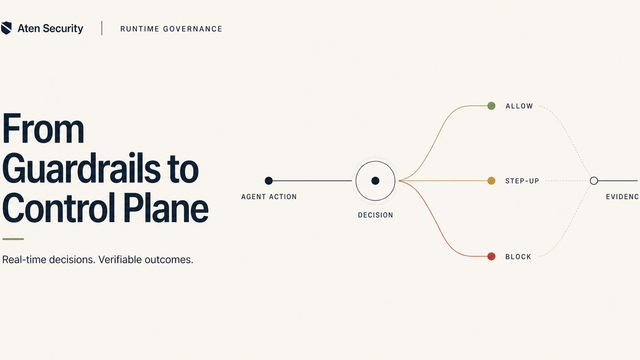
Active enforcement simulation demonstrated that out-of-scope or high-risk actions could be programmatically flagged or stepped-up via simulated multi-factor authentication (MFA) parameters without breaking the execution state or memory of the underlying agent.
{
  "trace_id": "thoth_audit_9f7a2b81",
  "timestamp": "2026-06-08T07:14:22Z",
  "agent_id": "coding_agent_secure_research",
  "tool_call": "mcp://local-ledger-sync/query",
  "arguments": {
    "scope": "pci_token_vault",
    "operation": "batch_export"
  },
  "policy_evaluation": {
    "matched_rules": ["Data Exfiltration Guard", "Token Access Limits"],
    "simulation_verdict": "STEP_UP",
    "latency_ms": 14.2
  }
}
Structural Gaps and Post-Pilot Adaptation
The design-partner framework was purposefully designed to expose edge cases and operational bottlenecks. The pilot highlighted two core friction points:
The Baseline Staging Window
The platform's predictive risk-scoring engines operated on a heuristic fallback rather than active machine learning models during the pilot. Because behavioral classifiers require historical data to prevent false positives, the initial 14-day window was consumed entirely by baseline data generation, delaying the safe activation of predictive scoring.
The Instrumentation Tax
The primary operational bottleneck was development overhead. Manually wrapping and instrumenting an internal agent whose codebase and tool configurations change weekly meant that platform engineers had to continuously rewrite integration files. At high startup development velocities, this manual upkeep cost can temporarily outweigh the immediate value of the telemetry captured.
Closing the Loop
To resolve the instrumentation friction highlighted by this design partnership, Aten Security has rolled out core platform SDK updates. These updates automate the agent wrapping sequence and automate triage path registration, eliminating manual maintenance code even as developer tool schemas evolve.
The pilot proved that while runtime agent controls are highly effective at capturing risk and securing data attribution, the long-term enterprise adoption of AI governance hinges entirely on minimizing the ongoing developer integration tax.
Get practical updates on AI agent security and governance.
Twice monthly notes on incidents, controls, and implementation lessons from real enterprise deployments.